
AI Scribes, Efficiency, and Professional Meaning
Why reducing documentation time may undermine professional fulfillment

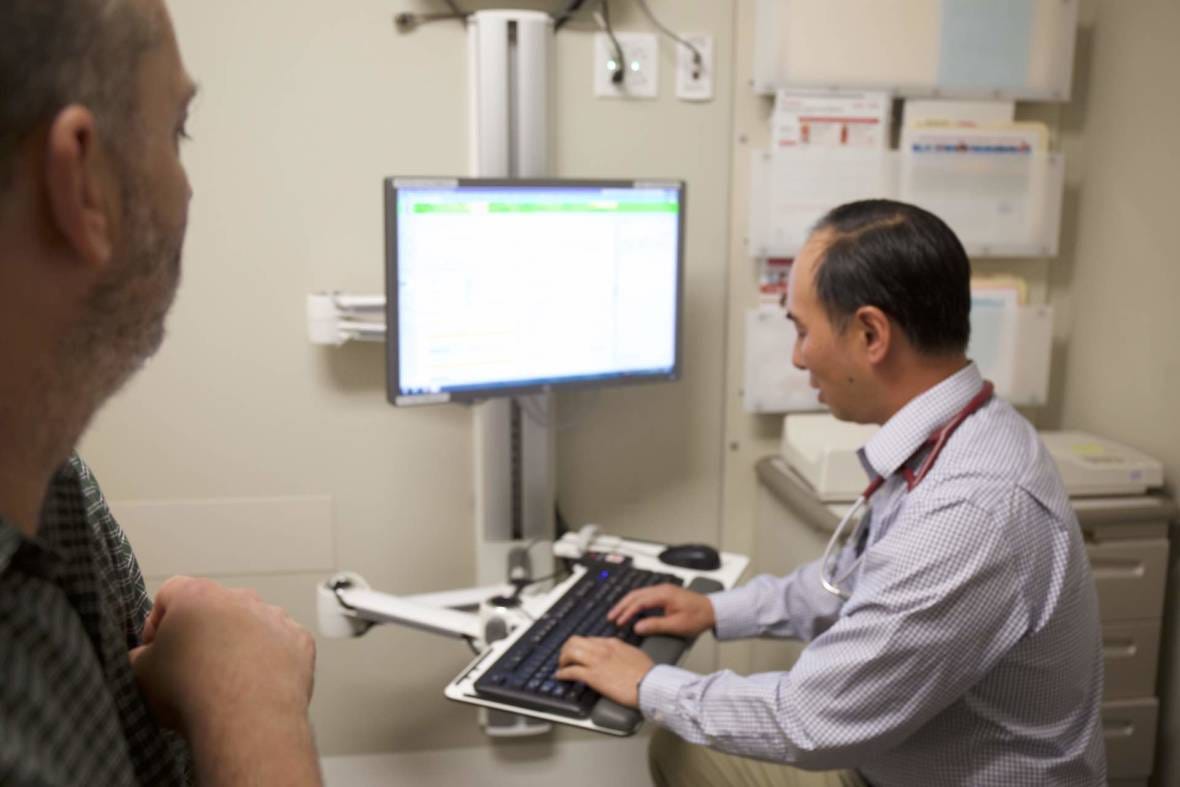
The growing excitement around artificial intelligence (AI)-based scribes in outpatient medicine is palpable and has been buttressed by recent research showing shorter documentation time, higher physician satisfaction, and reductions in burnout measures (1,2). On the surface, this looks like a clear win. When I read these studies, I think: “Fewer late nights finishing notes” and “Less time staring at a screen while a patient sits in front of me.” This feels like a breakthrough. But I am concerned about (i) what happens to the time AI scribes save and (ii) the effects of reduced cognitive interaction with patient data on how well we know our patients and how we derive meaning from clinical work.
In a pragmatic randomized trial of ambient AI, time spent on clinical documentation decreased by an average of roughly 22 minutes a day with associated reductions in work exhaustion and interpersonal disengagement (1). These findings are important and confirm that AI scribes reduce friction, free up time, and may improve well-being. That is encouraging, however, a similar model has been in place for decades. In academic medicine, resident and fellow physicians often function as de facto scribes, drafting notes as part of clinical training. They review the chart in advance, take the medical history, perform the physical exam, generate a preliminary assessment and plan, and draft the note. The attending physician then sees the patient, refines the thinking, teaches the trainee, and edits the note. For roughly three decades of my career, about 75% of my outpatient practice followed this model, with the remaining visits done entirely on my own.
That clinic experience has been instructive. When trainees are involved, I know the patients less well. I have less immediate recognition of names and faces, weaker recall of historical details, and a less intuitive grasp of where patients are in the arc of their illness. When labs return or patients call weeks later, I often am less efficient, because I have to reconstruct context that otherwise already would be in my head. I love working with trainees and appreciate the cognitive value they add to patient care: they think, question, and sometimes see things I miss. But delegation changes how my knowledge of the patient is encoded. When I am not the one reviewing the chart or constructing the narrative, my relationship to the patient’s story is thinner. That is the lens through which I view AI scribes.
A separate issue is what happens to the time that AI scribes save. In theory, less documentation should mean more time for patients, more thoughtful visits, and less work spilling into evenings and weekends (“pajama time”). In practice, efficiency gains in modern health care systems rarely are protected. Clinics under financial and operational pressure tend to absorb any freed capacity. Schedules get fuller and new tasks appear. The conveyor belt speeds up. We have seen this pattern repeatedly. Note templates made notes faster, then became standardized and strongly “suggested,” and panels grew. Order sets streamlined ordering and expectations rose. Patient portals improved access and message volume exploded. Each innovation promised relief, but ultimately redistributed or increased work rather than reducing it. There is little reason to believe AI scribes will be different. In environments optimized for throughput, saved time becomes an opportunity cost. It is hard to imagine health systems consistently choosing to protect that time for reflection, relationship-building, or presence when it can be converted into additional visits or measurable productivity.
This matters because burnout is often framed as a problem of time pressure, even though evidence suggests that time pressure is more of a symptom than a cause. The deeper drivers of burnout are loss of autonomy, loss of professional meaning, and the sense that clinical work is increasingly shaped by forces that constrain or devalue physicians’ clinical judgment (3). Against this backdrop, the NEJM AI findings are revealing: measures tied to transactional burden improve, while those reflecting intrinsic professional fulfillment are modest (1,2). Reducing documentation time may provide short-term relief, and that is important, but relief is not restoration.
There is another reason I am concerned. When trainees are involved, construction of the clinical narrative - the patient’s story - has been delegated, and that affects how my memory of them is encoded. This is where the difference between an AI scribe and a physician trainee becomes clear. Fellows and residents are not just scribes - they are thinking clinicians. They notice things, ask questions I might not have asked, generate hypotheses, and push back. They are engaged in the same cognitive work as I am. They carry part of the intellectual and moral weight of the visit - AI scribes do not. An AI scribe records and organizes what is said but it does not interpret or worry about what might happen next. It does not develop a longitudinal sense of the patient. When it contributes to a diagnosis or plan, there is a risk of forgetting that large language models are not knowledge repositories. They generate plausible sentences through statistical patterning, not understanding, and its authoritative-sounding narratives can obscure uncertainty or error. But a plausible narrative is not understanding. When I work with trainees, some of the thinking may be delegated, but it is still happening somewhere in the room. With AI scribes, the thinking is not redistributed; it is removed from part of the process.
Over time, that changes the nature of the work. Writing the note is where many clinicians integrate data, resolve ambiguity, and decide what should come next. It is a central moment of synthesis, where patterns are reinforced and memory consolidated. When that step becomes review rather than creation, the clinician’s relationship to the patient’s story becomes thinner. This thinning is not abstract. It shows up downstream in time and efficiency. When a test result returns or a message arrives weeks later, the physician who constructed the narrative often responds faster and with more confidence than the physician who signed off on one. The difference is not due to diligence or intelligence - it is familiarity born of synthesis.
Finally, I am most concerned about the psychological cost of this delegation, which is harder to measure and easier to ignore. For many physicians, satisfaction does not come primarily from efficiency. It comes from mastery, judgment, and the sense that one’s effort matters. Writing the note, imperfect and time-consuming as it is, anchors engagement and ownership. The note commits our thoughts, impressions, and judgment to writing. It is where we take responsibility and make our thinking explicit. When this work becomes supervision rather than creation, it can erode the sense that the work is one’s own. Signing off on a polished narrative is not the same as constructing it.
Technologies that reduce effort without preserving ownership may relieve fatigue
- a symptom of burnout - while accelerating a root cause of burnout itself.
We must remember that burnout is not just exhaustion - it’s a loss of meaning and value. It is the sense that one’s skills are underused, one’s judgment constrained, and one’s contribution is increasingly marginal. Technologies that reduce effort without preserving ownership may relieve fatigue - a symptom of burnout - while accelerating a root cause of burnout itself. None of this will be felt equally across generations. Physicians trained with these tools from the start may experience them differently, and their expectations of practice and sub-specialty choices may evolve alongside the technology. For many mid- and late-career clinicians, however, the shift from author to overseer may feel less like progress and more like loss.
There are reasonable counterarguments. Documentation has become distorted by billing and compliance, often failing to reflect meaningful clinical thinking. If notes are bloated and templated, automating them may simply acknowledge reality. Many physicians experience documentation as clerical rather than cognitive, so removing it may improve their professional lives. These arguments deserve consideration, but automating hollow documentation does not restore its meaning; it codifies the hollowness. The solution is not to remove clinicians further from the narrative, but to reclaim its purpose. And while future physicians may adapt to different tools and roles, there is a risk that internal medicine will become less attractive to people drawn by deep thinking, continuity, and problem-solving.
AI scribes may reduce friction and for many clinicians that will feel like relief. But tools that make it easier to move faster through the system do not necessarily make the work more sustaining. AI increasingly will become embedded in medicine. The harder question is whether we are willing to protect the parts of clinical work where synthesis, judgment, and ownership occur, even when technology makes them easier to bypass. If we do not, we may save minutes each day while losing meaning and value, which are harder to measure and far harder to recover.
References
1. Afshar M, Baumann MR, Resnik F, et al. A pragmatic randomized controlled trial of ambient artificial intelligence to improve health practitioner well-being. NEJM AI 2025;2(12). doi:10.1056/AIoa2500945
2. Lukac PJ, Turner W, Vangala S, Chin AT, Khalili J, Shih YCT, Sarkisian C, Cheng EM, Mafi JN. Ambient AI scribes in clinical practice: a randomized trial. NEJM AI 2025;2(12). doi:10.1056/AIoa2501000
3. Shanafelt TD, Dyrbye LN, West CP. Addressing physician burnout: the way forward. Mayo Clin Proc 2017;92(1):129–146. doi:10.1016/j.mayocp.2016.10.037
Well said and agree a 100%.
I abhor templates and don’t use them much.
When I read a heavily templated note it’s the intellectual equivalent to an eating junk food.
I am not optimistic. Those who make the decisions re these technologies have a different agenda. This is where our loss of autonomy most affects us.
Maybe as patients we can have our own personal health record and AI navigator and then “they” consult each other and then the doc and patient can have a nice conversation and mutually work through what the AI generates. I am only half joking. Then the doc writes a “real” note limited to the pertinent issues ie a true synthesis of the clinical encounter that when read later provides the narrative thread to the patients clinical “story”.
Very well stated. Being a doctor is partially being a craftsman, and the clinical note is your craft. I am old and sometimes crotchety and take a lot of pride in my notes. Thus, I became a slow convert to the AI-generated note. Part of the reason that I am a convert is that computer-generated text is now the norm, so most physicians are not viewing the clinical note as part of the craft and the note bloat and acronyms make the notes useless. I wrote an essay on the AI-generated note, which is also an homage to Lawrence Weed (https://roberteidus.substack.com/p/the-demise-of-the-clinical-encounter). For me personally, the biggest drawback of the AI-generated note is that the words are not my words (craftsman). The biggest advantage is that it takes me away from the computer and gives me more eyeball to eyeball contact. You did hit the nail on the head however, that the organizations that physicians work for (virtually all are employed who use AI-generated notes) are using it to increase throughput and not to reduce stress