
What’s My Name?

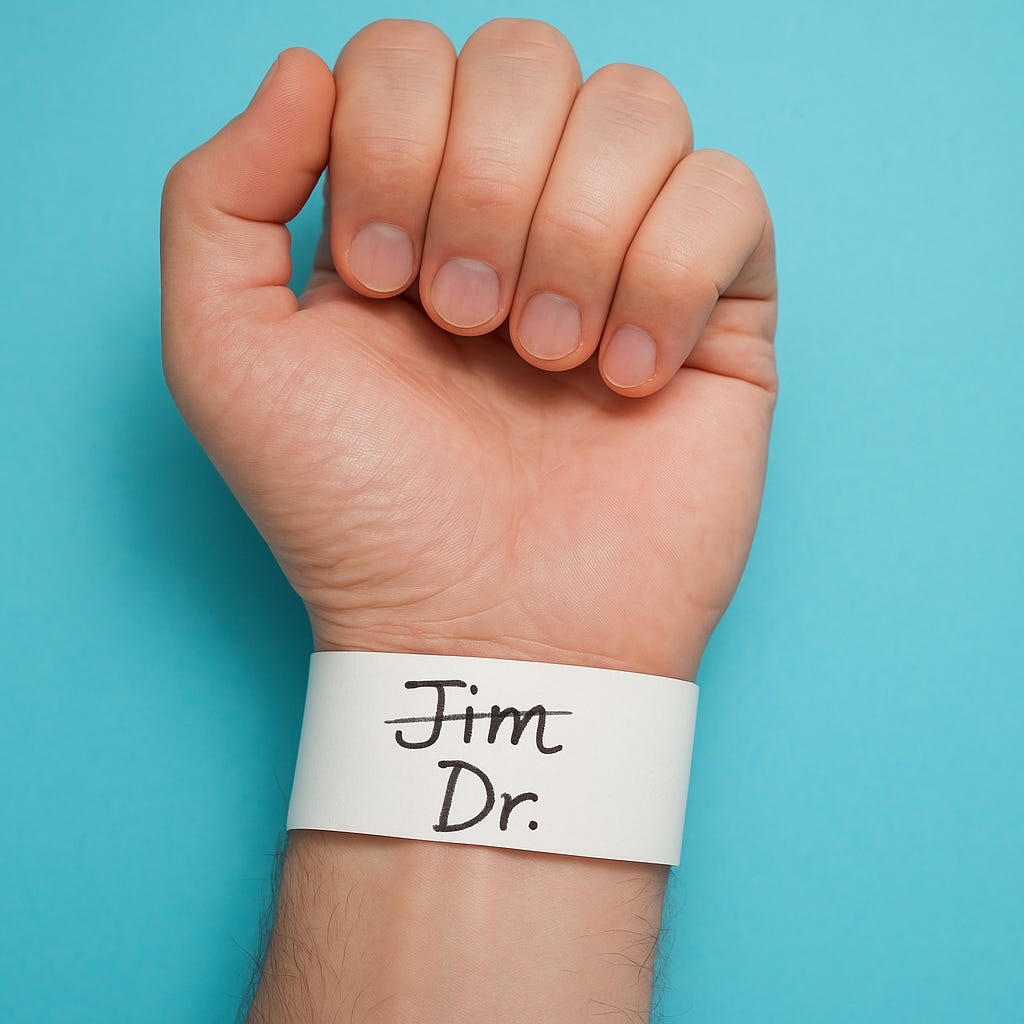
For most of my career, I never questioned what I should call myself when I became the patient instead of the physician. In medicine, names signal roles and expectations, and my personal approach always felt simple and natural: I was “Dr. Stein” in professional settings and “Jim” whenever I was receiving care, partly out of habit and partly out of trust. Lately, however, that distinction has started to blur, and I am uneasy about how and why I choose one name over the other. I keep returning to a question that troubles me: “What is my name in the health care system today, and why does it matter so much?”
A Lesson From My First Call Night
I remember the exact moment my relationship with my name changed. It was my first call night as an intern at the University of Chicago Hospital. I was paged to the fifth-floor general medicine nurses station. I was excited to be answering a page and eager to take my first real step into the world I had trained so long to join. When the nurse picked up, I said, “Hi, it’s Jim. I was paged.”
There was a short pause. Then she said, firmly, “Jim who?”
“Jim Stein. I’m the intern on the General Medicine Service.”
What came next was one of the most important lessons of my medical career. She said, without hesitating, “So you’re Dr. Stein. You need to identify yourself as ‘Dr. Stein’ because in medicine we need to know who you are. We’re not friends. You’re the doctor, I’m the nurse, and I need to know exactly who I am talking to before I can take an order.” Then she softened, just a little, adding, “And besides, honey, you’ve earned it.”
It was not a compliment - it was an instruction. It was about medical culture and patient safety. And it was empowering.
From then on, in any professional setting, I was “Dr. Stein” or “Dr. Jim Stein.” Not for ego, but for clarity and accountability. Names in medicine signal role and responsibility, but also authority. They structure communication in environments where misunderstandings can cause harm. I accepted that truth completely.
Who I Was When I Became the Patient
But as a patient, I was different. I never introduced myself as “Dr. Stein.” I introduced myself as “Jim.” When I checked in, when I answered questions, when I was called from the waiting room, I preferred the simplicity of my real first name. Part of that preference came from wanting to project warmth and humility and to sound like a nice, approachable person rather than an entitled physician looking for special favors.
I also trusted the systems we had built over many decades. Modern health care depends on standardized pathways, redundancy, and continuous process refinement. It is engineered to prevent small mistakes from becoming harm. And some of the biggest errors I have seen in my career occurred when someone deviated from the system, often with good intentions. I never wanted anyone to deviate from the system for me. I did not want shortcuts or special handling. I wanted to be treated like any other patient, because in many cases that is the safest way to be treated.
For a long time, that approach worked.
When Being “Jim” Stopped Working
Over the last decade the health care system changed. It became larger, busier, and more impersonal. Staff are overwhelmed, with too little time and support to do their jobs the way they believe they should. As the system shifted, my experience as “Jim” the patient began to feel slower and more fragmented. Messages took longer to reach the right person. Questions took more steps to resolve, and sometimes they were not resolved at all. At times the staff seemed irritated, as if I were bothering them. After all, I was just another name on the schedule or another inbox message to clear, and the machinery around me treated me that way.
Yet when I identified myself as “Dr. Stein,” or listed it as my preferred name in the electronic medical record – so that it appeared beside my photo – the experience shifted immediately. My calls and inquiries were returned more promptly. Responses were clearer, more helpful, and noticeably kinder. The system responded very differently and I am not sure why. Was it simple courtesy, or was it my status? Was it respect, or did my title mark me as an insider who understood the unspoken codes of the system, almost like a secret handshake?
I did not change my name out of vanity or pride. I changed it because the system left me feeling compelled to do so. And that, more than anything else, is what bothers me.
The Uncomfortable Truth is That It’s Privilege
My friends and colleagues have widely varying opinions about my shift to using “Dr. Stein” when I am a patient. Some say this happens in every field: connections matter and insiders always navigate complicated systems more smoothly. Others say that after three decades here in Madison, I can’t separate “Dr. Stein” from “Jim Stein” and that I should use whatever advantages I have to help myself. Still others remind me that the system is difficult for everyone and that if I know how to make it work better for myself, I should.
But a different group of friends tell me something harder to hear: that what I am experiencing is privilege, and that it is fundamentally unfair. It reflects an unequal system that gives better care to people who know how to signal that they belong on the inside. They are not wrong. None of them are.
That is why this sits so uncomfortably with me. I do not want to rely on something others cannot access. I do not want to believe that my care depends on a title rather than on my needs. I have been a health care professional for more than thirty-five years and am proud that my identity has always been grounded in fairness, justice, and respect for persons. And I especially dislike recognizing that the system behaves differently depending on who it thinks you are.
So What’s my Name Now?
I’m not sure anymore. Some days I feel like “Jim.” Other days I feel like “Dr. Stein.” Sometimes “Dr. Jim Stein” fits better. However, I use my title much more now, not because I want to, but because I have learned that I need to, and that bothers me. When I am a patient and I introduce myself as “Dr. Stein,” I’m trying to make a few things clear: I am a person and I want to be treated with care and professionalism. I want my health care to be efficient and excellent. I want to be treated with respect, and I refuse to be rushed through the system as if I were simply another task to complete. But the truth is that no one else wants that either.
Every patient in every health setting deserves the level of respect, attention, and competence that the system provides for insiders. Yet the system does not always work that way, and that leaves me asking why any of this should depend on the name I use.
My discomfort is not about ego. It is about a health system that reacts differently to people based on what their name seems to communicate, instead of what their care actually requires. Maybe the real question is not what I call myself, but why everyone else does not automatically receive the level of care that my title seems to unlock.
So I keep coming back to the same question: What is my name, and why does it matter so much in a system where every patient should matter equally? This is health care, after all, and health is a basic human right – which is why I became “Dr. Stein” in the first place.
I have always been “Mary” in these situations, and I bristle and go red when my chart has been flagged or listed as “Dr”…for all the reasons you’ve outlined. I’ve luckily never dealt with serious medical situations (yet!), and I agree that I’d like to receive the same care as anyone else. The only time I reveal is to save the provider the need to explain things extensively on a non-medical “typical” patient basis…although that also is revealing. I have that title in reserve and (begrudgingly) used it for advocating for my father when he was a patient at the end of life. And I’d not hesitate to pull the card out of the wallet if push came to shove. But the paradox is real. Thanks for your point of view!
I can relate to this on so many levels. This year, my parents - who are Korean immigrants, whose first language is not English have come up with the first major medical issues in their adult life. And though it’s not the fault of individual providers, I realize that their accent and their limited medical language versatility puts them at the back of the line within the medical system.
And thus, I have resorted to being on every call, being present on every visit that I can, and always reinforcing I am a physician. Is it fair? No. Certainly not. But I know it helps in expediting their care and the thoughtfulness of every step in the process. What wouldn’t you do for the people you love? It’s a tough question. My name and title seems like the very least that I can do. But I completely understand the discomfort that it instills.