
Why I Stopped Counting Steps
A smartphone metric that was making me less healthy

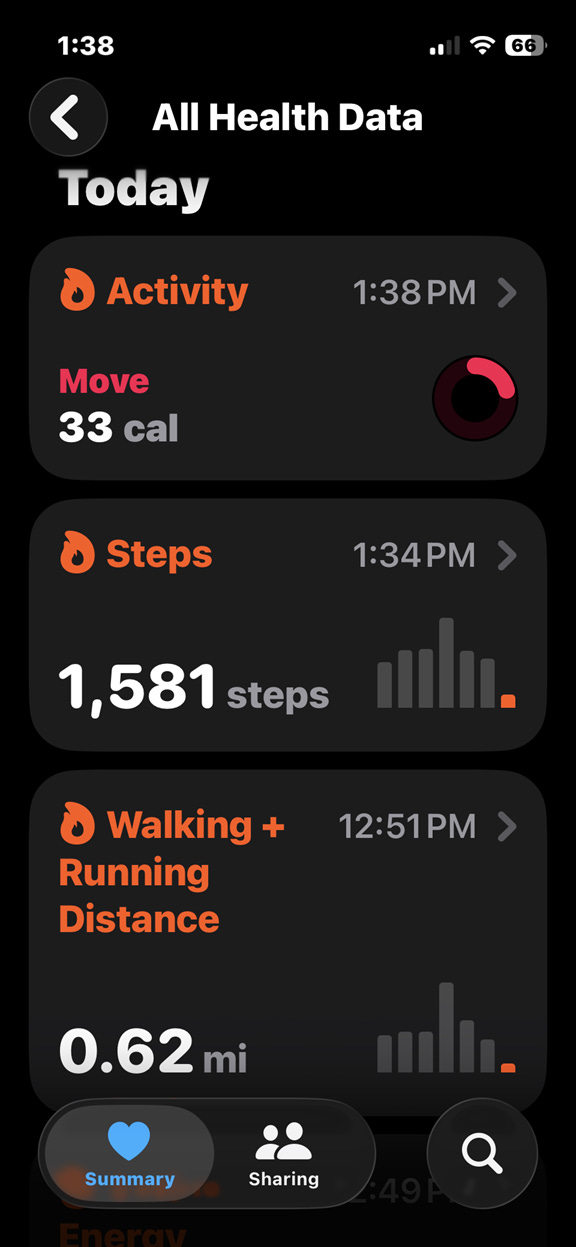
I gave up my pedometer a few weeks ago and am much happier than I expected. My pedometer lives in my iPhone, which was a problem. I have been trying to avoid being on my phone so much, but the only way I could see my step count was to pick it up. Smartphones distract people from living life and suck people into the alternate, unhealthy world of the internet and social media; that is what they are built to do. It turns out that the tool I was using to encourage physical activity was pulling me back into the sedentary habit I had been trying to limit, and that should have been reason enough to stop.
But following my steps also made my life worse in ways that, to be honest, are embarrassing for someone like me, who studies cardiovascular disease prevention and sees cardiology patients for a living. For example, sometimes I invented reasons to walk if the step count was a few hundred short of a round number, like 7,000, or a made-up goal, like 10,000. Since inadequate sleep is one of my personal health risks, it certainly did not make any sense to stay up later walking around the house to get in a few hundred more steps. And when I left my phone in the other room or in the car, I found myself counting steps in my head and using that tally to update the pedometer count, instead of simply being present in the world around me. That may sound obsessive, but I have friends and patients who do these sorts of things, too, because they think it is “healthy.”
Finally, I am an active person. I already know that I have a stable pattern of taking 6,000 to 7,000 steps a day, and I also cycle, swim, and do resistance training about five times a week. So I asked myself the obvious question: what was counting my steps actually doing for me?
How an ad slogan became a health prescription
The 10,000-step target has no physiological basis. The origin story is a Japanese pedometer from the mid-1960s called the manpo-kei, which loosely means “the ten-thousand-step meter.” It was a catchy round number attached to a consumer device, not a threshold discovered by exercise scientists. The number survived because it was memorable, specific, and easy to put on a screen. Over time, a marketing target came to feel like a biological one (1).
To be clear, this origin story does not mean walking is unimportant. Walking is among the safest and most useful things a person can do, and for some people, it is the only form of exercise they can do safely. But this story means that 10,000 steps is not a commandment or a physiological line between health and failure.
What the observational data show about people who walk more
Large observational cohorts consistently show that people who take more steps have lower mortality during follow-up. In a prospective cohort study of over 16,000 women, mortality declined as daily steps increased and appeared to level off around 7,500 steps per day (2). A meta-analysis of 15 cohorts found that the association flattened around 6,000 to 8,000 steps per day for adults 60 years and older and around 8,000 to 10,000 steps per day for younger adults (3). But the curve is steep at the bottom and flatter in the middle. Moving from 2,000 to 5,000 steps/day is associated with larger health improvements than moving from 8,000 to 11,000. That should be obvious physiologically, but the consumer version of pedometry hides it. The screen gives one number and the internet supplies one target.
There also is the unavoidable problem of reverse causation. Some of the association between step count and mortality almost certainly reflects the fact that people who are healthier are more able to walk. People who are ill, frail, depressed, or developing disease walk less. If an observational study sorts people by step count at baseline, the lowest step-count group will include more people whose low activity is a consequence or marker of illness, not necessarily the cause of future illness. People with higher step counts also may differ from people with lower step counts in many ways that are hard to measure, including baseline health, mobility, mood, social support, and access to safe places to walk. Researchers try to handle this by adjusting for known conditions and excluding early events; the associations often persist, albeit weaker, but observational data cannot fully separate walking as a cause of better health from walking as a sign of better health.
Pedometers can help inactive people walk more
In a meta-analysis of pedometer interventions to increase walking, pedometers worked. Pedometer users increased their steps by about 2,000 to 2,500 steps/day over 4 to 5 months (4). The subsequent PACE-UP trial showed that a pedometer-based walking program could produce modest increases in activity among people who were not meeting physical activity goals. The step-count increases declined by one year but still were present (5).
These studies suggest that for someone who is not very active, a pedometer can convert an abstract instruction like “move more” into something concrete and actionable. It can reveal that a day spent mostly sitting is even more sedentary than it felt. For that person, the number may be useful not because 10,000 steps is magic, but because feedback can change behavior. But the behavioral benefit seems to be strongest at the lower end of the activity distribution. Once a person has a generally active life, the marginal value of step counting gets much smaller.
What the number misses
It also is vital to remember that step counts are not the same as physical activity. Pedometers can make anyone who bikes, swims, rows, lifts weights, or does a lot of non-ambulatory work look mediocre (6). A swim and a strength session may leave a person with a disappointing step number, but a phone that bounced in the car all day can make them look awesome. The number on your phone feels precise, but it is not necessarily measuring the thing we actually care about. Furthermore, no large trial has randomized people to a specific daily step target and shown fewer cardiovascular disease events or deaths as a primary endpoint. The randomized trials show that pedometers can modestly increase activity and improve some cardiovascular disease risk factors over the short and medium term. But the hard-outcome data mostly come from observational associations, which are useful but clinically limited.
When tracking changes the behavior it is supposed to measure
I think the more interesting problem is not accuracy. It is what the number does to the person looking at it. Once movement becomes a score, it no longer is neutral; it can become a credit, a debt, or a judgment. I experienced my step count as yet another distracting demand on my attention and my time, but many others use it as license to change other behaviors. In the E-MECHANIC randomized trial, supervised exercise increased caloric intake in many participants and partly offset the expected weight-loss effect (7). That does not mean exercise causes overeating; it means that the human response to exercise is not straightforward: some people move more and then eat more, sit more, or treat activity as something they have earned the right to spend.
A different wearable trial gets even closer to my concern. Participants who were given artificially deflated step count feedback (i.e., they were told they had taken fewer steps than they actually had) felt less adequate and subsequently experienced worse affect, self-esteem, mental health, and blood pressure despite no actual reduction in physical activity (8). In other words, the number on the screen changed how people experienced their health, independent of what their bodies actually had done.
The number on the screen changed how people experienced their health, independent of what their bodies actually had done.
Neither finding proves that pedometers are bad, but they do illustrate the downsides of step counting. A device that makes an inactive person more active may be useful, but a device that makes an already active person feel inadequate, check their phone more often, sleep less, or convert movement into an accounting exercise may be doing something else.
Why I stopped counting
I am not against walking. I recommend it often and enjoy it myself. I am not against pedometers for people who are inactive, recovering from illness, or looking for a simple prompt to move more. But I am against confusing a metric with a goal (cf. Goodhart’s Law) and confusing achieving that goal with being healthy.
For me, step counting had stopped providing useful information. I already knew I was in a healthy range of daily walking and I exercised regularly. I already had the habits the pedometer was supposed to encourage, so instead of adding health, it added phone checking, mental arithmetic, sleep disruption, and a subtle sense that an active day was incomplete unless a device approved of it.
So I stopped, and the only thing I gave up was the pretense that a number generated by a 1960s marketing idea, made more persuasive by observational curves, and never validated as a universal treatment target was telling me something I needed to know. For some people, a pedometer is a useful tool. For me, it had become one more machine telling me to leave real life and return to the screen.
References
1. Tudor-Locke C, Bassett DR Jr. How many steps/day are enough? Preliminary pedometer indices for public health. Sports Med. 2004;34(1):1-8. doi:10.2165/00007256-200434010-00001
2. Lee I-M, Shiroma EJ, Kamada M, Bassett DR Jr, Matthews CE, Buring JE. Association of step volume and intensity with all-cause mortality in older women. JAMA Intern Med. 2019;179(8):1105-1112. doi:10.1001/jamainternmed.2019.0899
3. Paluch AE, Bajpai S, Bassett DR Jr, et al. Daily steps and all-cause mortality: a meta-analysis of 15 international cohorts. Lancet Public Health. 2022;7(3):e219-e228. doi:10.1016/S2468-2667(21)00302-9
4. Bravata DM, Smith-Spangler C, Sundaram V, et al. Using pedometers to increase physical activity and improve health: a systematic review. JAMA. 2007;298(19):2296-2304. doi:10.1001/jama.298.19.2296
5. Harris T, Kerry SM, Limb ES, et al. Effect of a primary care walking intervention with and without nurse support on physical activity levels in 45- to 75-year-olds: the PACE-UP cluster randomised clinical trial. PLoS Med. 2017;14(1):e1002210. doi:10.1371/journal.pmed.1002210
6. Strath SJ, Kaminsky LA, Ainsworth BE, et al. Guide to the assessment of physical activity: clinical and research applications: a scientific statement from the American Heart Association. Circulation. 2013;128(20):2259-2279. doi:10.1161/01.cir.0000435708.67487.da
7. Martin CK, Johnson WD, Myers CA, et al. Effect of different doses of supervised exercise on food intake, metabolism, and non-exercise physical activity: the E-MECHANIC randomized controlled trial. Am J Clin Nutr. 2019;110(3):583-592. doi:10.1093/ajcn/nqz054
8. Zahrt OH, Evans K, Murnane E, et al. Effects of wearable fitness trackers and activity adequacy mindsets on affect, behavior, and health: longitudinal randomized controlled trial. J Med Internet Res. 2023;25:e40529. doi:10.2196/40529
Well said! I was very motivated by the step count on my smart watch at first, but over time became less so , for reasons similar to those you have detailed. However, there are many other metrics measured by smart watches, some with unclear value, and unknown reliabilty. As a relatively old (64!) and experienced physician, I will admit to not having a great deal of knowledge about the significance of heart rate variability. When I recently experienced an unusually severe bout of a type of nonspecific pain that I am familiar with from many past occasions, I was very alarmed to see a major drop in my HRV over the days that I was symptomatic, paired with a 10 beat increase in my resting heart rate. Recognising my own lack of knowledge about the significance of this, I realised that very few of the colleagues that I might consult with would know much more about it either. I was able to learn, with some research, that virtually any acute stress, including acute pain, can lower HRV, and that it is not a specific marker of cardiac issues. Clearly my pain and stress increased my sympathetic response, which explains these changes to me. However, considering how alarmed I first felt on seeing these measures, I can only imagine how much more alarming it might feel for someone who could not as readily find and understand that information. I am sure that you, Jim, like myself, and many of our colleagues, have been, and will increasingly be approached by patients with questions and concerns about metrics they see on their wearable devices and don't understand. It behooves all of us to learn about these, so that we can properly advise (and, at least some of the time, reassure) our patients about their significance, but there remain many unanswered questions about the reliability of the measures and their translation to clinically informative data. And for metrics where we do not yet fully understand the significance, I wonder if measuring them for people is helping or harming them?
Great and original column. I’ve never seen these issues addressed so effectively.